
Captain R C V Ross, on board one of those destroyers, said: “On 21st June 1919 the big ships and destroyers had proceeded to sea for gunnery and torpedo practice.....we were actually picking up our torpedoes after a run when we received the electrifying signal: ‘German Fleet sinking. Return to harbour at full speed.’ We were back inside the Flow far ahead of the battleships...... In all directions the great German super-dreadnoughts and cruisers were indeed sinking: some rolling over and going down with great bubbles, others settling on an even keel, or sliding under bows first.”
Chaplain G L Bourdillon, on board HMS Royal Sovereign, wrote to his wife: “The first sign we saw was the masts of a ship at a sharp angle over Flotta. Half the German ships had disappeared and several of the remainder were in a sinking condition! One battleship had her quarter-deck awash, and as we watched thro’ glasses, we saw her gradually lift her bows out of the water, roll over and disappear below the surface, leaving nothing but a vast patch of bubbling foam. It was one of the most thrilling sights I have witnessed… I then came down to see the prisoners coming aboard. Boatload after boatload, in they poured, officers and men, till we had over 400 of them on board! They were quartered mostly in the batteries both sides. All the arrangements worked smoothly, but there wasn’t much sleep for anyone last night."
They left at 6 am to take the Germans to Cromarty, arriving at noon and heading back to Scapa by 5 pm, to undertake salvage work and save what they could of the fleet.
Bourdillon said: “We are now tidying up. The mess everywhere was awful, and the odour!!!”
The First World War ended with the Armistice of 11 November 1918. The Allied powers agreed that Germany's U-boat fleet should be surrendered without the possibility of return, but could not agree about the fate of the surface fleet. The Americans suggested that the ships be interned in a neutral port pending a decision. Following the refusal of Norway and Spain to host the fleet, it was agreed that the fleet be interned at Scapa Flow in Orkney with a skeleton crew of German sailors, and guarded in the interim by the Grand Fleet. The terms were forced on the Germans by the threat that failure to agree would result in the invasion by the Allies of Heligoland.
176 U-boats, which began arriving at Harwich on 20 November 1918, were surrendered. The surface fleet was met by the light cruiser HMS Cardiff on the morning of 21 November, and was led to the rendezvous with over 370 ships of the Grand Fleet and other allied navies. There were 70 German ships in total; the battleship König and the light cruiser Dresden had engine trouble and had to be left behind. The destroyer V30 struck a mine while crossing, and sank. The German ships were escorted into the Firth of Forth, where they anchored. The fleet was then moved between 25 and 27 November to Scapa Flow. Eventually, a total of 74 ships were interned there, König and Dresden having arrived on 6 December accompanied by the destroyer V129, which replaced the sunken V30. The last ship to arrive was the battleship Baden on 9 January 1919.

Over the next two months, sailors who had brought the Fleet in were repatriated, leaving some 1700 men as skeleton crews. Conditions were dreadful. The men were not treated as prisoners of war and were considered to be the responsibility of Germany. Germany was in chaos following its defeat and provisioned the men with the scantest of rations on a monthly basis. Sailors were forbidden to fraternise with the crews of the other ships or to leave their ships to set foot on Orkney. They fished from the deck of their ships and caught gulls, but abandoned that when they discovered gulls made poor eating. Defying orders, they went in the ship's boats around the guard ships, asking for food and saying they were starving. They put ashore on Hoy and stole sheep. The Navy responded by taking all the boats and beaching them on Hoy. Discipline was poor, the men were bored and they had no soap, hence the appalling smell described by Bourdillon.
Meanwhile, the Allies continued to squabble over the spoils of war. At the Paris Peace Conference, the French and Italians each laid claim to a quarter of the ships. The British wanted them destroyed, since they knew that if the others got their hands on them, the British Navy would lose its proportional advantage over the navies of their allies. The Armistice forebad the Germans destroying their ships. It was feared that scuttling would be attempted; Admirals Keyes and Leveson recommended that the ships be seized anyway and the crews interned ashore at Nigg Camp, but their suggestions were not taken up.
The Treaty of Versailles was scheduled to be signed at noon on 21 June 1919. Rear Admiral Ludwig Von Reuter, fearing that the terms of the Treaty would be unacceptable to Germany, in which case hostilities would be resumed and the British would seize the German Fleet to wage war on Germany, issued his orders to the Fleet on the 18th June. "It is my intention to sink the ships only if the enemy should attempt to obtain possession of them without the assent of our government. Should our government agree in the peace to terms to the surrender of the ships, then the ships will be handed over, to the lasting disgrace of those who have placed us in this position."
 |
| This is the scuttled battlecruiser, SMS Hindenburg, resting on the sea bed of Scapa Flow. |
Preparations were made. Stopcocks were greased, sledge hammers placed ready, and holes knocked in bulwarks to facilitate incoming seawater flowing into the ships. Arrangements for abandoning ship were put in place.
Oberbootsmannmaat (Petty Officer) Franz Müller was shot by a British guard aboard SMS Markgraf when he refused to stop opening the seacocks.

During the afternoon, 1,774 Germans were picked up and transported by battleships of the First Battle Squadron to Invergordon. Admiral Fremantle had sent out a general order declaring that the Germans were to be treated as prisoners-of-war for having broken the armistice and they were destined for the prisoner-of-war camps at Nigg. Reuter and several of his officers were brought onto the quarterdeck of HMS Revenge, for a good shouting at by Fremantle – through an interpreter – denouncing their actions as dishonourable while Reuter and his men looked on "with expressionless faces". Admiral Fremantle subsequently remarked privately, "I could not resist feeling some sympathy for Reuter, who had preserved his dignity when placed against his will in a highly unpleasant and invidious position."
Of the 74 German ships at Scapa Flow, 15 of the 16 capital ships, 5 of the 8 cruisers, and 32 of the 50 destroyers were sunk. The remainder either remained afloat, or were towed to shallower waters and beached. The beached ships were later dispersed to the allied navies, but most of the sunken ships were initially left at the bottom of Scapa Flow, the cost of salvaging them not worth the potential returns, owing to the glut of scrap metal left after the end of the war, with plenty of obsolete warships having been broken up. After complaints from locals that the wrecks were a hazard to navigation, a salvage company was formed in 1923, which raised four of the sunken destroyers.
In 2019, the three battleships Markgraf, König and Kronprinz Wilhelm were sold on eBay (by the retiring diving contractor Tommy Clark) for £25,500 each to a Middle Eastern company. The cruiser, Karlsruhe, sold for £8,500 to a private bidder in England.
The low-background steel harvested from the ships is used in the manufacture of radiation-sensitive devices, such as Geiger counters, as it is not contaminated with radioisotopes, having been produced before any chance of nuclear contamination.
The Treaty of Versailles imposed harsh penalties on Germany, including war guilt, reparations, territorial losses, and military restrictions. We've seen how Reuter responded, by scuttling the Fleet. The Versailles settlement failed to establish lasting peace, the humiliation creating a desire for revenge and national restoration, which Adolf Hitler and the Nazi Party exploited to gain support. The German resentment and loss of face as a great Power was exacerbated by the severe economic crises, including the Great Depression, of the Twenties and Thirties. Germany and Italy, facing economic pressures and limited access to resources, pursued aggressive expansionist policies to secure markets and raw materials, continuing the imperial rivalries that had led to World War I and seeking to overturn the Versailles territorial settlements and rebuild their influence in Europe.
The First World War led to the Second World War, as night follows day. Essentially, World War II was a continuation of World War I because it arose from the same unresolved issues: punitive peace terms, economic hardship, nationalism, and imperial competition. And the Second World War led to the migration crisis of the twenty-first century. In the aftermath of the Second World War, the immense loss of life created labour shortages in Britain, France and Germany and Sub-Saharan Africans began migrating into Europe. The French, in particular, welcomed workers from its former Empire, as part of the Françafrique system of retaining ties between France and its many colonies in West Africa, like Senegal, Mali and the Ivory Coast.
Following the Second World War and the breakup of the British Empire, Indian migration to Britain increased through the 1950s and 1960s, partly due to the British Nationality Act 1948, which enabled migration from the Commonwealth with very few limits. In the aftermath of the Second World War, these links facilitated significant flows of people from across the Commonwealth to Britain, helping to rebuild the economy, expand public services, and address acute labour shortages. Britain’s labour shortages shaped post-war migration patterns from the subcontinent. It was primarily men from middle-ranking peasant families in Punjab – many of whom had previously served in the colonial army – who came. They found work in manufacturing, textile mills, and the service sector. The textile mills of Bradford and the foundries of Birmingham became magnets for Indian workers.
There is no labour shortage in Britain now - but there is a labour imbalance, which is disadvantaging white indigenous young people, who seem unable to find the entry-level jobs any more.
My dad was with the Royal Army Medical Corps at the D Day Landings in June 1944. He described the sky black with gliders towed by bombers, providing air support and parachutists in Operation Tonga and Operation Overlord. The D-Day landings, involved over 156,000 Allied troops storming five beaches in Normandy. Of these, 4,414 Allied servicemen died during the initial 24 hours of the invasion, including 2,501 Americans, 1,449 British, 391 Canadians, and 73 from other Allied nations. Total Allied casualties, including wounded and missing, were around 10,000 on that day. German losses on D-Day are estimated to be between 4,000 and 9,000 killed during the landings
The D-Day invasion was the largest seaborne assault in history, involving 7,000 ships, 11,000 aircraft, and over 150,000 troops.
The operation started the beginning of the liberation of France and Western Europe from Nazi occupation. My dad marched with that Army of liberation across Europe to Berlin, where he assisted in the cleaning out of the concentration camps.
D-Day should be commemorated every year. Damn it, it is personal. It lives in the memories of Britons and Europeans living today. Every family remembers their menfolk who fought and died together. Or survived, coming home changed and determined to build a better world. The start of the death of deference. The collapse of empire. A world in which the state is responsible for its citizens rather than seeing them as cannon fodder or breeders of cannon fodder.
So, and this is where I've been aiming through this essay - did Pete Hegseth desecrate that memory in his D-Day speech yesterday? He criticised European nations about migration for allowing what he described as an "invasion" of their shores. "Sadly, today, different European beaches are stormed by different dangerous ideologies. Beaches in Spain, in Italy, in Greece and Bulgaria. Boats and men arrive. When will European capitals do something about that invasion?"
And should he butt out, as the Sage of Tottenham opined this morning? This is European stuff, after all. And Hegseth's a Yank.

Hell, no. D-Day belongs to the American allies as much as to the European allies. And he's right. Hegseth’s speech argued that the Second World War shaped the modern world, that the consequences of that war still reverberate and that today’s geopolitical and demographic realities are rooted in the twentieth century’s conflicts. Here's the structural link: empire led to world wars which led to decolonisation which led to migration.
 |
Migrant tents in Paris. May 2025. Now that's not right.
Hegseth said that in the years since D-Day some European capitals have grown too "comfortable" with their hard-fought freedoms, forgetting that "freedom is not free. The men who fought and died here restored freedom to Europe. That freedom must be maintained by this generation of leaders and war fighters or what they fought for was merely temporary."
He's right.

.............................................................................
There are four splendid anthologies of the writings of stanislav and mr ishmael, compiled by his friend, mr verge, the house filthster. You can buy them from Amazon or Lulu. Here's how:
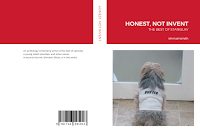


 Honest Not Invent, Vent Stack, Ishmael’s Blues, and the latest, Flush Test (with a nice picture of the late, much lamented, Mr Harris of Lanarkshire taking a piss on a totem pole) are available from Lulu and Amazon. If you buy from Amazon, it would be nice if you could give a review on their website.
IIshmaelites wishing to buy a copy from lulu should follow these steps
please register an account first, at lulu.com. This is advisable because otherwise paypal seems to think it's ok to charge in dollars, and they then apply their own conversion rate, which might put the price up slightly for a UK buyer. Once the new account is set up, follow one of the links below (to either paperback or hardback) or type "Ishmael’s Blues" into the Lulu Bookstore search box. Click on the “show explicit content” tab, give the age verification box a date of birth such as 1 January 1960, and proceed.
Link for Hardcover : https://tinyurl.com/je7nddfr
Link for Paperback : https://tinyurl.com/3jurrzux
https://www.lulu.com/shop/ishmael-smith/flush-test/paperback/product-9yjvn7.html?q=Flush+Test&page=1&pageSize=4
At checkout, try WELCOME15 in the coupon box, which (for the moment) takes 15% off the price before postage. If this code has expired by the time you reach this point, try a google search for "Lulu.com voucher code" and see what comes up.
With the 15% voucher, PB (including delivery to a UK address) should be £16.84; HB £27.04.


